The hand is where a robotics concept meets the product. A robot may navigate well, recognize a bottle and plan a convincing motion, yet still fail because its contact slips, crushes the packaging or blocks the barcode. For grocery work, selecting the end effector deserves its own evaluation.
There is no universal winner between a vacuum tool, a two-finger gripper and a dexterous hand. The right choice depends on what must be grasped, how it must be moved and what must happen when the first attempt fails. This guide offers a comparison method for mixed grocery products and existing retail workstations.
Compare contact methods before counting fingers
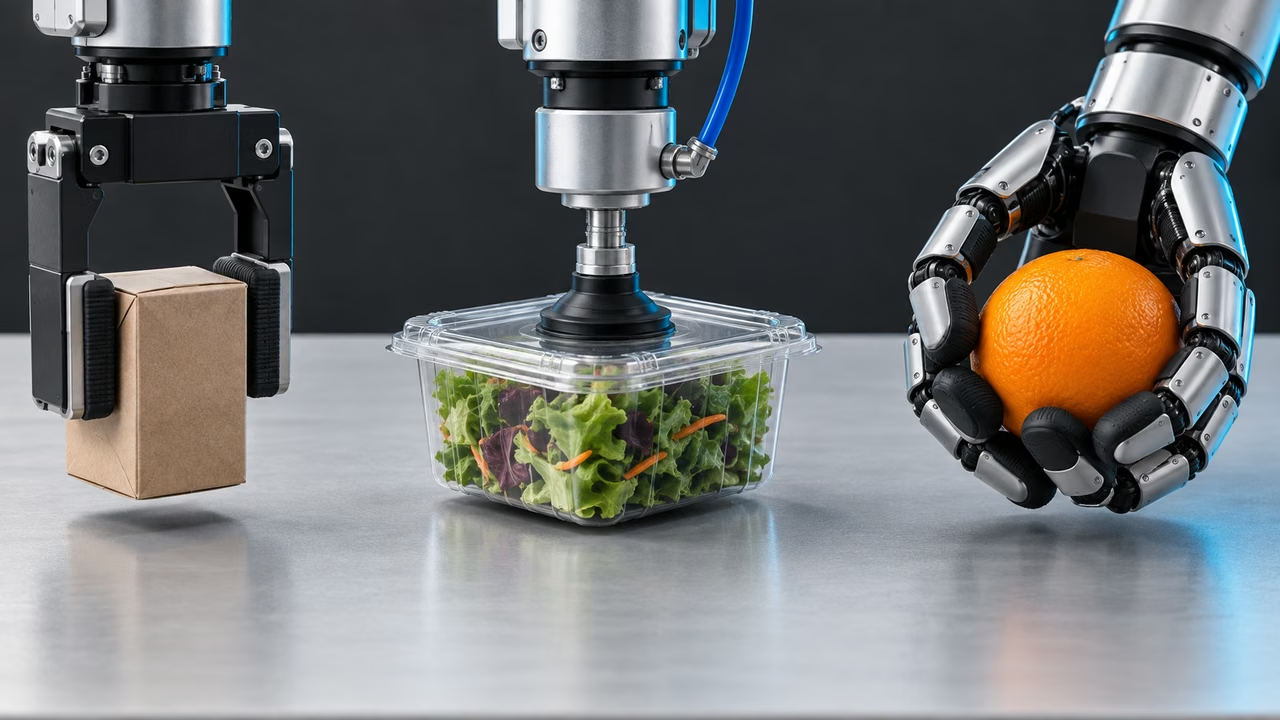
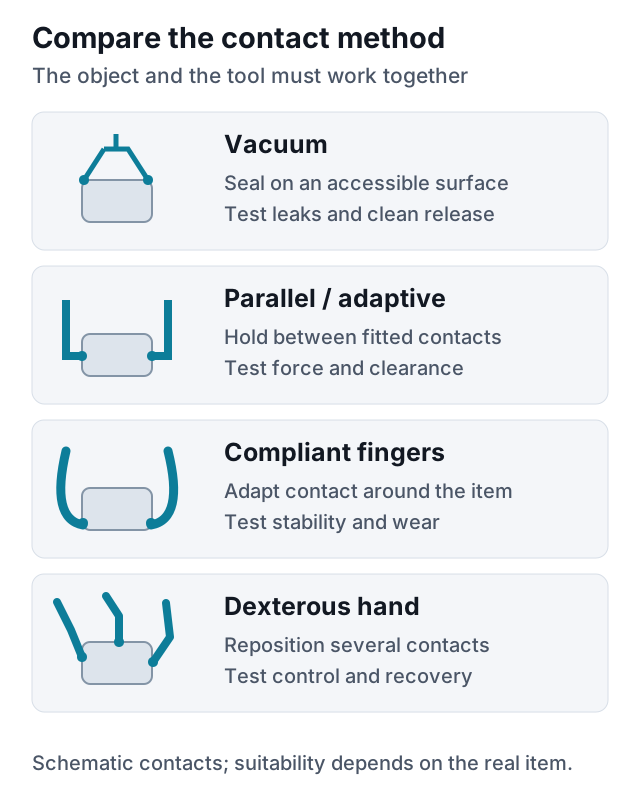
Start by asking how the tool will hold the item. Will it seal against a surface, squeeze it between fingers, support it from below or wrap around it? Each approach creates different requirements for the product and the surrounding space.
| Tool category | When to investigate it | What to test carefully |
|---|---|---|
| Vacuum | Items with accessible surfaces that can support a suitable seal | Leaks, porous or wrinkled packaging, labels, cup placement and release |
| Parallel or adaptive fingers | Items with accessible sides or geometry that supports a stable grasp | Opening width, friction, crushing force, finger clearance and orientation |
| Soft or compliant fingers | Irregular or delicate items where contact adaptation may help | Holding stability, wear, repeatability, cleanability and release accuracy |
| Dexterous hand | Tasks requiring varied contacts, finger repositioning or interaction with human-oriented controls | Control complexity, sensing, durability, reachable grasps and recovery |
These are investigation paths, not blanket suitability claims. A vacuum arrangement can be engineered for some porous materials; a gripper can use custom fingers to cradle a product. The useful comparison concerns the complete tool and object combination, not its category name.
What named products can tell you—and what they cannot
Robotiq’s documentation illustrates a key procurement detail: adaptive-gripper payload varies by model and grasp mode, and compatibility involves the mounting pattern and communication interface. A payload figure without its grasp conditions is not a complete specification.
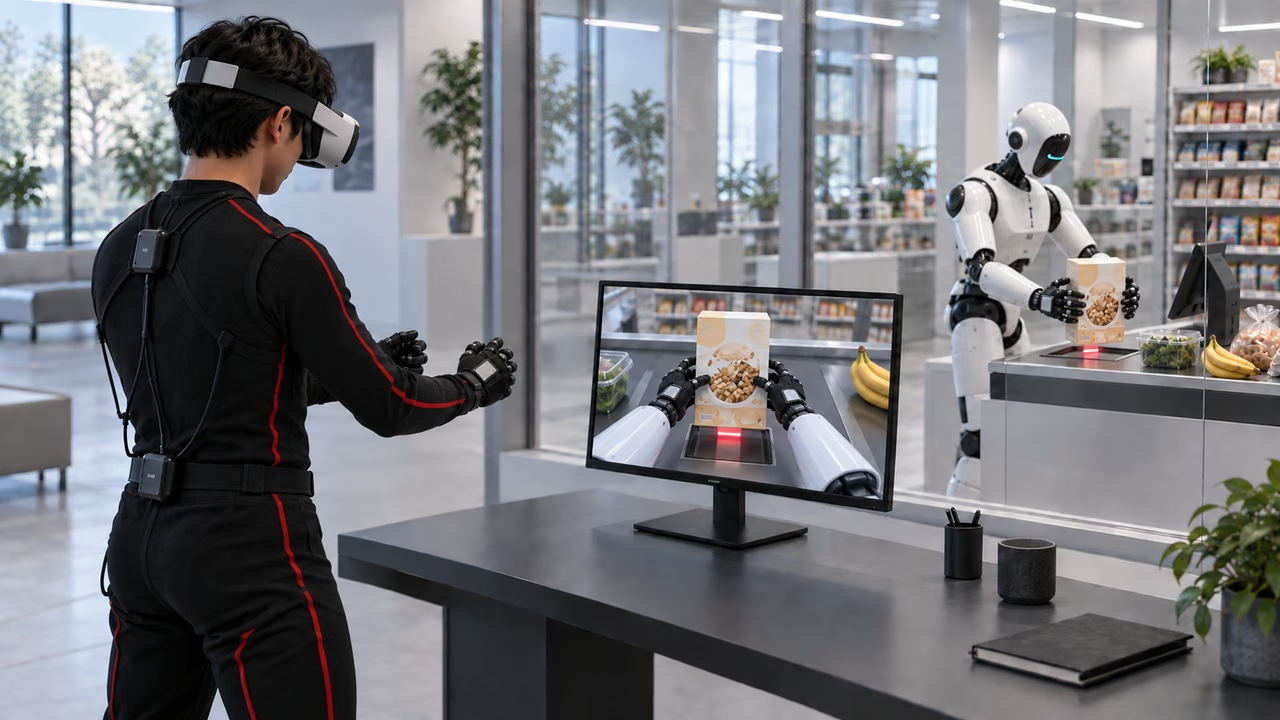
Shadow Robot’s Dexterous Hand is an example of a five-finger research tool with tendon actuation, sensing and teleoperation options. Unitree’s G1 EDU information describes an optional three-finger Dex3-1 hand and optional tactile arrays. These examples show different hardware and sensing arrangements; they do not establish which one will handle your grocery basket best.
For a shortlist, request the exact hand revision, fingers, tactile options, driver support and mechanical interface. Also establish who owns the integration. A hand being available for one robot does not demonstrate compatibility with another platform or with your required software stack.
Build a grocery test basket around failure modes
A test consisting only of clean rigid boxes is too narrow for most checkout or replenishment work. Select representative products from the intended operation, record their condition and include duplicates so that damage or packaging changes do not silently change the test.
| Example item | Question the test should answer | Evidence to record |
|---|---|---|
| Rigid cereal carton | Can the tool grasp without denting it or hiding the required barcode? | Grasp location, damage inspection, scan success |
| Filled bottle | Does the grasp remain stable as the center of mass moves? | Slip, orientation, release position |
| Flexible pouch | Does deformation change the grasp or its reliability? | Wrinkles, leakage, failed pickup and recovery |
| Transparent or glossy tray | Can perception and contact remain reliable under changing reflections? | Pose errors, grasp attempts, placement accuracy |
| Delicate packaged produce | Can the task finish without unacceptable pressure or damage? | Inspection criteria and delayed damage where relevant |
Add the store’s difficult products deliberately. Test them in realistic orientations and shelf clearances, not only in an ideal pickup pose. Separate unsupported items from items expected to work. That boundary gives staff a usable operating rule.
Payload is a system calculation
The item is not the only mass the arm carries. Tooling, adapters, cables and sensors consume capacity too. Their position also changes the load on the wrist. Ask the robot supplier to assess the actual end effector and motion envelope rather than comparing an item’s weight with one headline payload number.
Similarly, maximum gripping force is not a quality score. Some products need lower contact pressure or a supporting geometry. A heavier bottle might be better held with a secure shape fit than with greater squeezing force. Test acceleration, deceleration and direction changes because a successful static hold does not prove a stable transfer.
Touch helps, but it does not remove the need for evaluation
Tactile or force feedback can add information about contact and loading. Shadow’s sensor documentation distinguishes sensing approaches that provide contact and force information. That is useful context for asking what a proposed tool can actually observe.
For your task, ask a more specific question than “does it have touch?” Can the controller detect the beginning of a slip? Does it know the difference between touching the product and touching the shelf? What action follows an unexpected force reading? Is the sensor’s useful information available to the task software, or only to a diagnostic display?
Additional sensing is valuable only if it improves the intended behavior and can be maintained. Calibration, damaged fingertips and dirty surfaces belong in the operating plan.
Touchscreen work is a separate capability
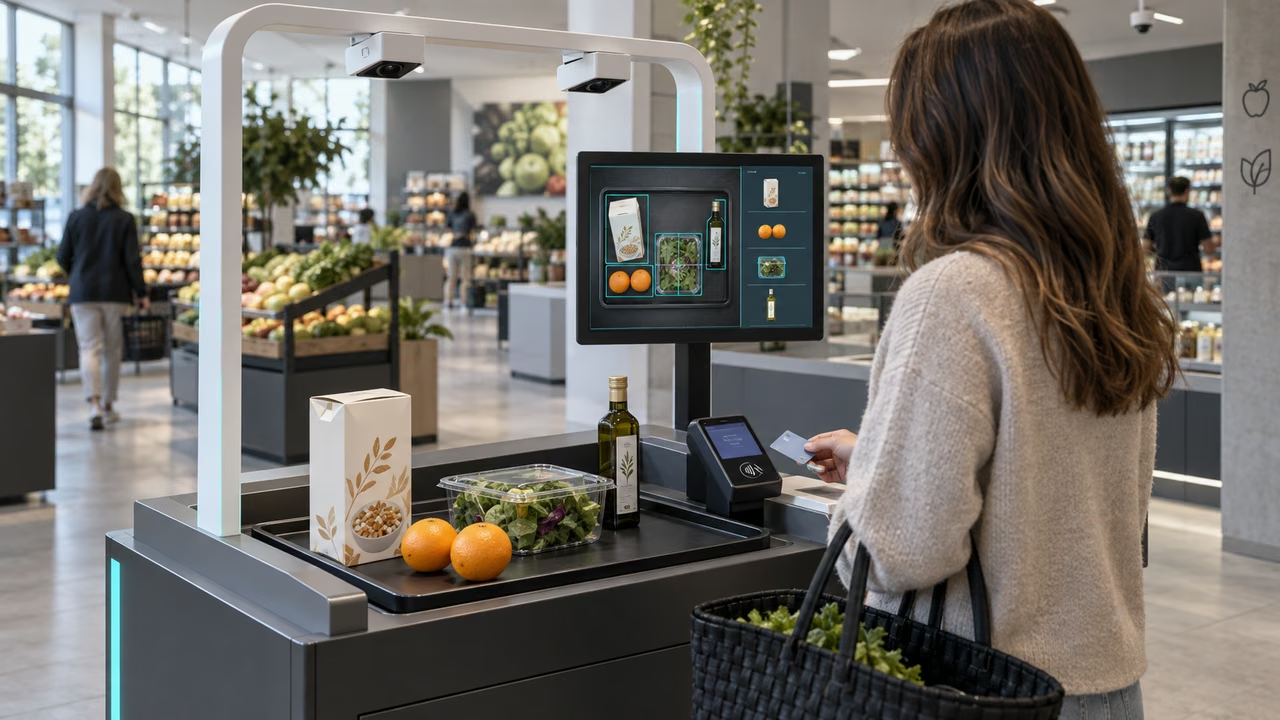
A hand that handles groceries may also need to press an existing checkout interface. Evaluate that as a separate task. Screen compatibility, fingertip geometry, approach angle, force, visual occlusion and the recognition of the next screen state all matter.
Do not combine “the finger touched the button” with “the correct transaction state was reached.” A repeated tap after a delayed response can be worse than a missed tap. Define how the system confirms an action, how it avoids unwanted repetition and when it hands control back to a person. The pilot planning guide explains how to include these exceptions in acceptance criteria.
Measure recovery and damage alongside speed
For each item family, report first-attempt success, eventual success after recovery, human intervention, product damage and total cycle time. Keep the number of attempts visible. A high overall success percentage can hide a weak category that matters commercially.
Hypothetical example: in a 200-item evaluation, tool A completes 190 items without help. Tool B completes 194. But A damages one item and B damages eight. Neither result should be compressed into a single “success rate” until the definition of acceptable completion includes the agreed damage criteria.
Time should include failed attempts and resets. Record the median and a slower-tail measure, such as the 90th percentile, with the sample size. Add time for fingertip changes, cup replacement, cleaning and calibration. A faster motion can produce a slower shift if it demands frequent attention.
A practical end-effector decision
- Choose the representative object set and task boundaries.
- Eliminate tools that cannot meet workspace, interface or handling constraints.
- Test the remaining configurations under identical conditions.
- Repeat with held-out products and changed placements.
- Inspect damage and record every recovery or human intervention.
- Compare total operating effort, maintenance and usable throughput.
A more elaborate hand is justified when its additional capabilities solve an important task that simpler tooling cannot solve well enough. Simpler tooling is attractive when it meets the same acceptance criteria with less operating effort. Let the evaluation decide.
Use this analysis alongside the grocery robot selection guide and the sim-to-real training guide. To scope a FastLane discussion, bring a representative item list and the required movements. Those details are more useful than a request for a particular number of fingers.
Sources and further reading
- Robotiq: gripper payload and compatibility questions
- Robotiq: vacuum tooling configurations
- Shadow Robot: Dexterous Hand Series
- Shadow Robot: tactile sensing options
- Unitree: G1 and optional hand configurations
Product examples checked in September 2026. The test matrices and numerical example are editorial evaluation tools, not reported FastLane test results.