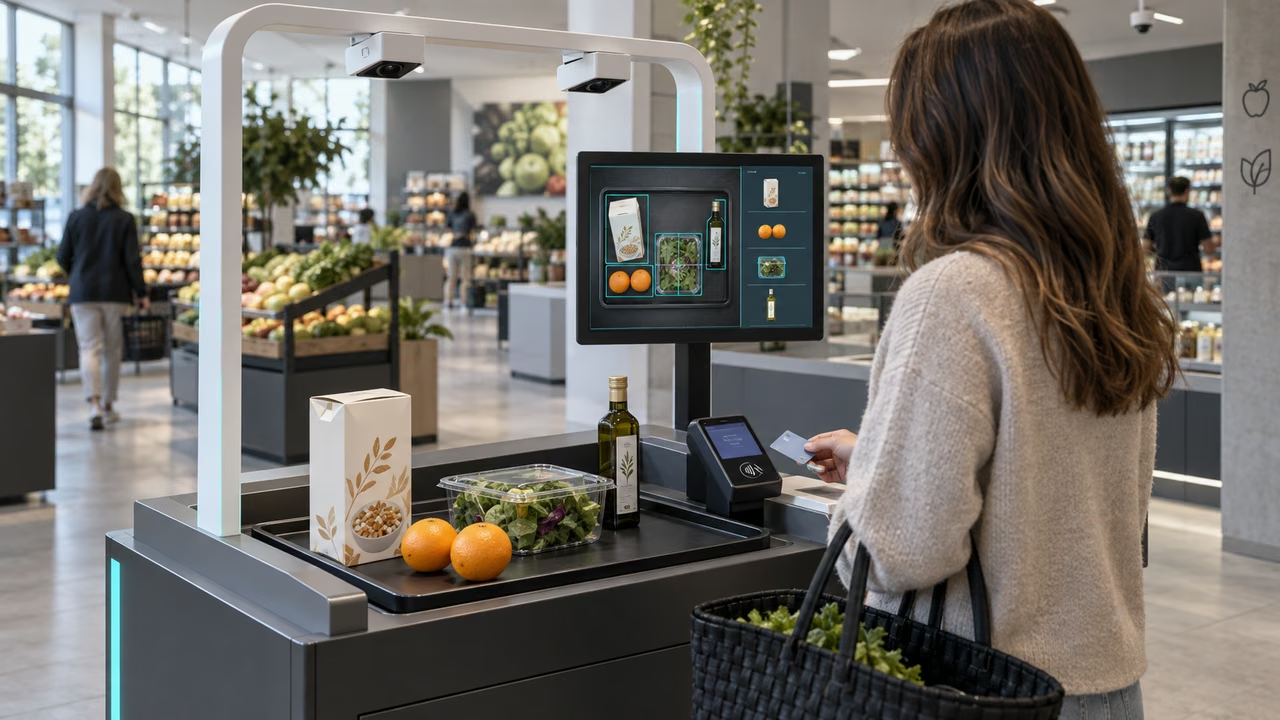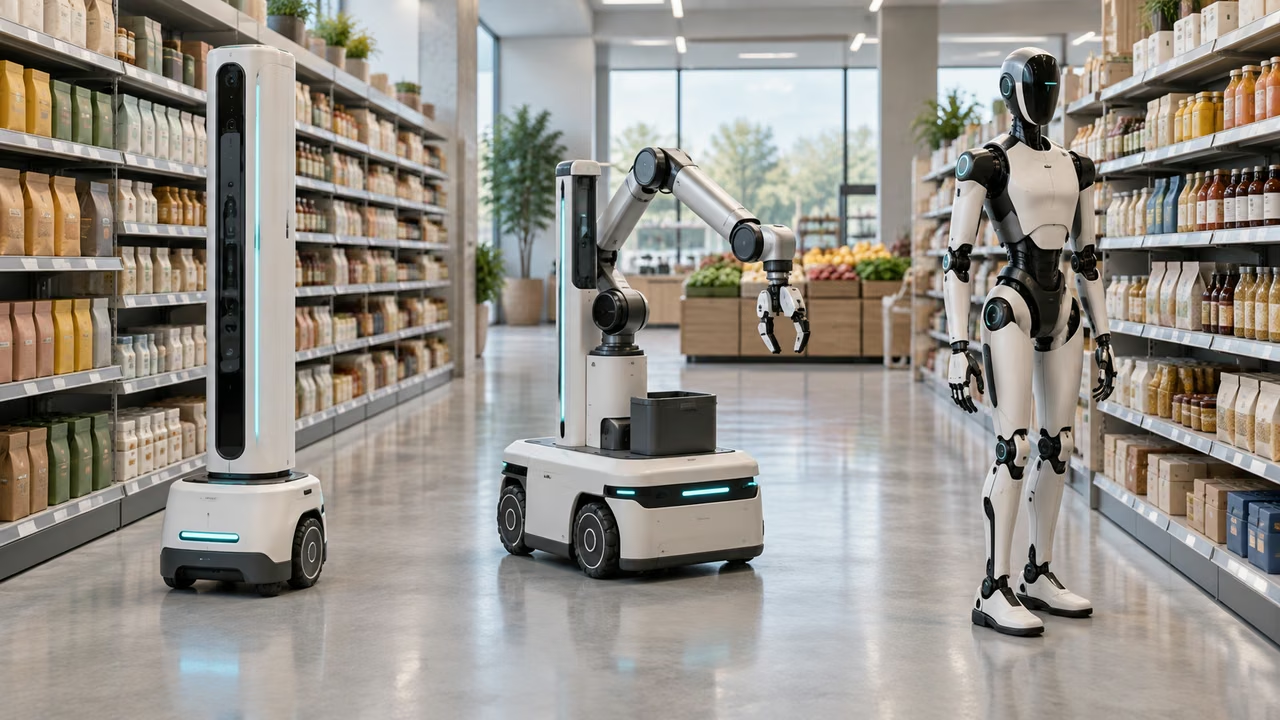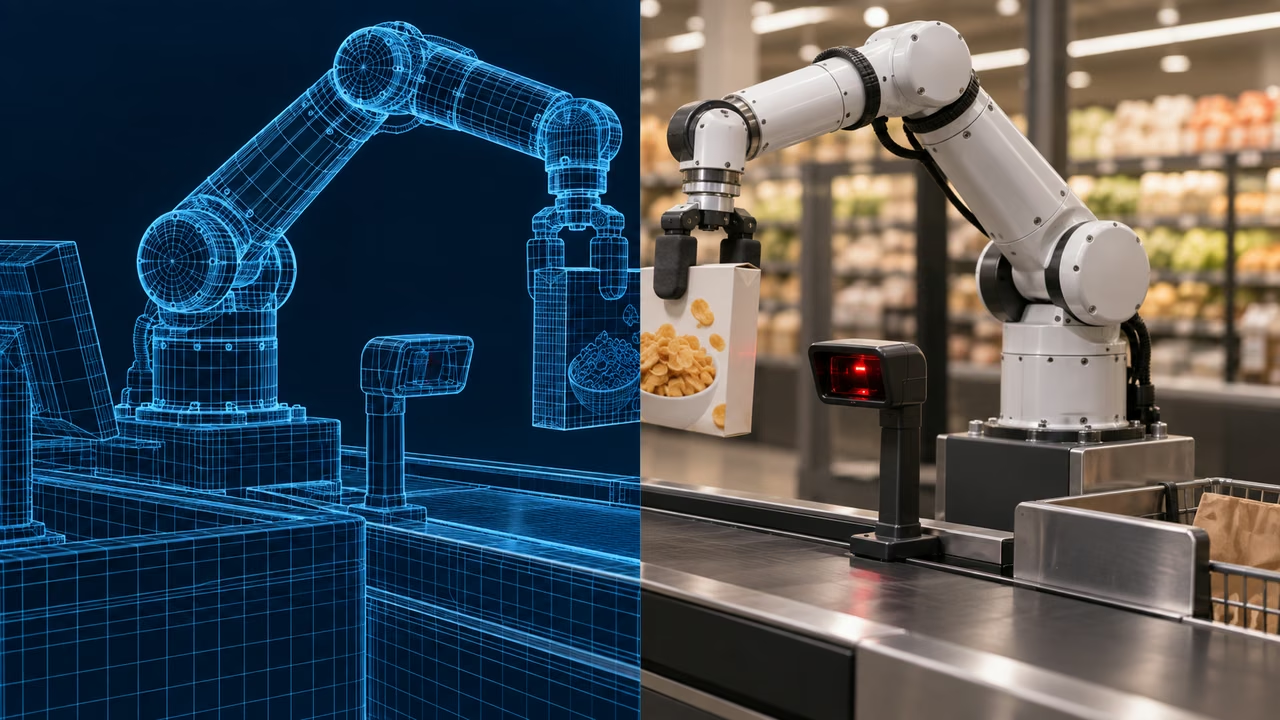
A robot that succeeds in a simulated supermarket has passed a useful development test. It has not yet demonstrated that it can perform the same task reliably beside real products, store fixtures and customers. Sim-to-real learning is the process of bridging that gap—and measuring what remains uncertain.
For a retailer, the important question is not whether a supplier uses simulation. It is how simulation contributes to the proposed workflow, what was tested on actual hardware and what evidence supports the next deployment stage. This guide explains the process without requiring a background in machine learning.
Four terms worth separating
- Simulation represents the robot, its sensors and an environment in software. It allows controlled experiments without rebuilding the physical scene for every trial.
- A policy is the decision rule that turns observations into actions. It might command a movement or choose a higher-level step within a larger system.
- Imitation learning trains behavior using demonstrations of a task. The quality and coverage of those demonstrations matter.
- Reinforcement learning trains behavior through interaction and a defined objective or reward. The objective must reflect the behavior actually wanted.
These methods can be combined. NVIDIA Isaac Lab, for example, supports robot-learning workflows including imitation and reinforcement learning on top of Isaac Sim. A tool’s capabilities do not determine whether a particular checkout workflow has been validated.
Teleoperation is another distinct ingredient: a person controls the robot to perform a task, potentially creating demonstration data. A recording of that task does not by itself show autonomous behavior. The teleoperation guide explains the different operating modes.
A useful simulation starts with a measurable task
“Handle groceries” is too broad to be a good first training specification. A more useful task might be: pick a supported item from a defined area, present its barcode to a scanner and place it in a defined destination without damage. Even that task contains perception, contact, motion and state-verification problems.
Record the workstation geometry, reachable areas, permitted contacts, item categories and successful ending state. Include what the system should do when it cannot find a valid grasp or the scanner does not confirm a read. A well-defined refusal or handover can be the correct result outside the supported operating envelope.
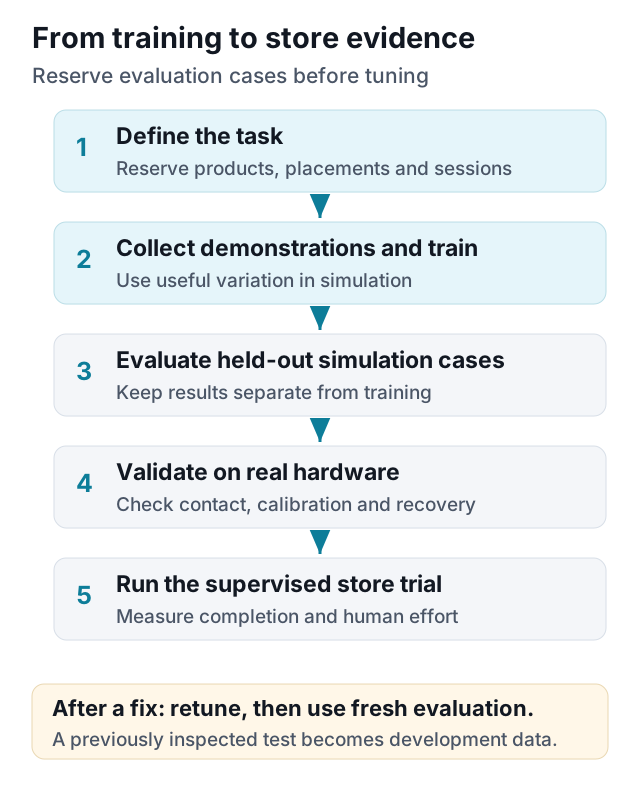
The training-to-pilot sequence
- Measure the real task. Capture the relevant geometry, sensor positions, object properties and workflow states.
- Collect representative demonstrations. Record the observations, actions and outcomes needed for the chosen learning method, with consistent timing and quality checks.
- Build and check the simulation. Confirm that basic geometry, motion limits, contact behavior and sensors are plausible before increasing training scale.
- Train across useful variation. Change conditions that the physical system is likely to encounter.
- Evaluate held-out scenarios. Test conditions reserved from training, with a clear definition of acceptable completion.
- Calibrate and test the physical robot. Check perception, tooling and control behavior in a controlled workcell.
- Run a supervised store pilot. Expand the operating envelope only when the preceding evidence supports it.
- Learn from classified failures. Fix the appropriate layer—data, tooling, perception, task logic or operating process—and retest.
This is a development framework, not a promise of a fixed delivery schedule. Some failures need better data. Others require a different fingertip, fixture or task boundary. More training alone does not resolve every physical limitation.
What should vary in a virtual grocery environment?
Domain randomization changes selected simulation parameters so the policy does not depend on one idealized scene. NVIDIA’s sim-to-real tutorial distinguishes visual variation from physical variation and describes both benefits and limitations. For retail, choose the ranges from plausible operating conditions rather than randomizing everything indiscriminately.
| Variation | Retail reason to include it | Physical check still required |
|---|---|---|
| Lighting and reflections | Packaging and screens look different across a store and throughout the day | Actual cameras with glossy, dark and transparent surfaces |
| Item pose and placement | Products arrive rotated, offset or partly obstructed | Reach, finger clearance and stable contact |
| Mass and friction | Similar-looking products can move differently | Slip and deformation on representative real packages |
| Camera position and calibration | Small setup changes can alter perceived geometry | Calibration tolerance and drift |
| Action and observation timing | Commands, sensors and interfaces do not respond instantly | Measured timing across the complete physical system |
| Workflow state | An interface or surrounding process can present an exception | Recognition, confirmation and a safe handover path |
Too little variation can produce a brittle solution. Implausibly broad variation can waste effort or encourage unnecessarily conservative behavior. The operating envelope should guide the training distribution.
Where the reality gap is most likely to appear
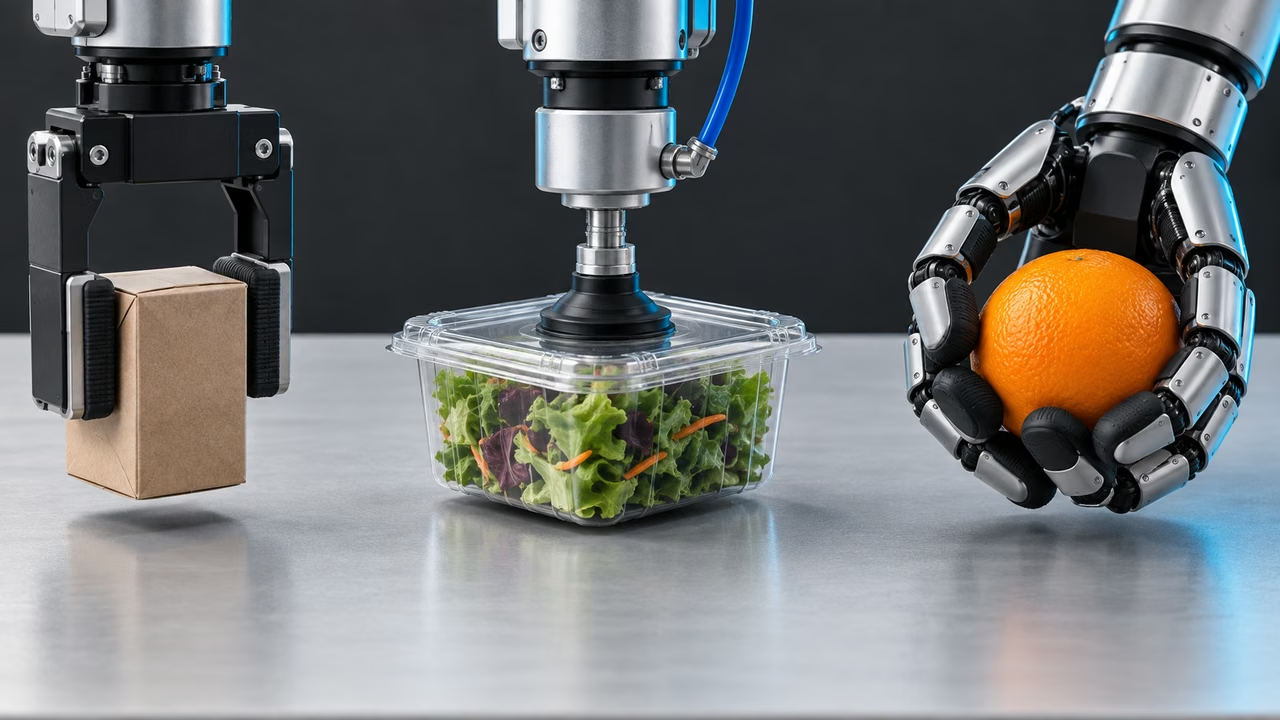
Contact-rich work deserves particular attention. A rigid virtual carton is easier to model than a flexible pouch whose shape changes when grasped. Packaging friction, suction leaks, worn contact surfaces and a slight calibration error can interact in ways that a tidy scene does not capture.
The learning framework can provide tools for sensor and actuator modeling; the Isaac Lab framework paper describes those capabilities. Their presence is a reason to build better experiments, not to skip hardware testing.
Separate physical contact failures from interpretation failures. If the robot chooses the wrong screen state, improving grasp simulation may do nothing. If it recognizes the right item but repeatedly drops it, revising the end-effector design or contact strategy may be more useful than adding visual examples.
Keep training and evaluation apart
A demonstration replay is valuable during development, but it is a weak final test. Reserve products, placements and recording sessions before tuning. Near-duplicate views of the same scene should not be presented as independent proof of generalization.
A practical evaluation can contain three groups: familiar products in new placements; previously unseen products within supported categories; and deliberate out-of-scope cases where the expected action is to stop or hand over. Report these groups separately. Their mixture can make one overall percentage misleading.
Hypothetical example: a system passes 96 of 100 familiar-item trials and 58 of 100 held-out-item trials. Reporting 77% overall success hides the difference that matters for assortment expansion. Neither number is a FastLane benchmark; the example shows why test composition belongs beside the result.
Changing a policy after inspecting a failed test is normal engineering. That test has now become development evidence. Use a fresh reserved set for the next independent acceptance check.
Measure store outcomes, not just learning scores
A simulator reward or training curve is not a cashier throughput figure. Translate evaluation into the task: correct completion, product damage, assistance, recovery, available operating time and total elapsed time per attempt. Keep aborted attempts and resets in the record.
Ask for the duration and conditions behind a result. Ten successful trials in one arrangement and a multi-session evaluation across a changing item set provide different evidence. A useful report makes those differences visible without hiding behind a single accuracy claim.
Evidence to request before a store pilot
- A written task definition and explicit supported operating envelope.
- A list of training data and evaluation data categories.
- The representative physical products and fixtures used for testing.
- Uncut trial recordings with total attempts and failure categories.
- Results separated by item type, novelty and recovery mode.
- The person or local process responsible for every exception.
- A change log connecting fixes to subsequent retests.
Simulation earns its place by making preparation more systematic and exposing failures earlier. Real hardware and a well-scoped retail pilot determine whether the resulting behavior meets the operating need.
Discuss a training and pilot plan with FastLane using the workflow, representative products and workstation constraints. Those inputs help turn a promising virtual task into a testable physical project.
Sources and further reading
- NVIDIA: Isaac Lab overview
- NVIDIA: domain randomization and demonstration collection
- Isaac Lab: a GPU-accelerated simulation framework for multi-modal robot learning
- AnyTeleop: primary research on arm-hand teleoperation
The retail test framework and worked example are editorial guidance. Research demonstrations and framework features are not evidence of a particular FastLane deployment result.