When a robot handles a grocery item in a video, a useful question is: who is making the decisions? A person may be controlling every movement, guiding one part of the task or providing occasional help while the robot operates independently. Those are different operating models with different staffing and technical requirements.
Teleoperation can be valuable in retail robotics. It can help collect demonstrations, test manipulation strategies and recover from selected exceptions. The important step is to describe its role honestly and design the handover process before measuring performance.
Separate four operating modes
| Mode | What the person does | What a buyer should establish |
|---|---|---|
| Direct teleoperation | Commands robot actions while observing the task | Operator effort, feedback, communication and permitted actions |
| Shared control | Provides input while software constrains or assists movement | Which decisions belong to the person and which to the system |
| Supervised autonomous operation | Monitors a robot carrying out its defined task | Monitoring responsibility, intervention triggers and local support |
| Remote assistance | Responds to particular requests during otherwise independent work | Request frequency, handling time, queueing and return to operation |
Terminology varies between suppliers, so ask for a concrete demonstration of each mode. A person choosing an object on a screen is doing different work from a person continuously controlling a hand. Neither should be hidden inside an unexplained autonomy percentage.
Teleoperation is also a way to teach
Demonstrating a grasp can be more practical than describing every joint movement by hand. The recorded observations and actions can support imitation learning, provided their quality and coverage match the task.
Two research examples illustrate this connection. Open-TeleVision uses immersive visual feedback and collects demonstrations for learned manipulation skills. AnyTeleop studies a vision-based approach across different robot arms, hands and virtual or physical settings. These are useful primary sources on demonstration collection; their experiments do not establish grocery-store deployment performance.
For retail, the teaching task could be a defined sequence: grasp a supported package, present it to the scanner and place it in the destination. Demonstrations should include realistic placement variation and a clear successful ending state. The sim-to-real guide explains how to keep training examples separate from acceptance tests.
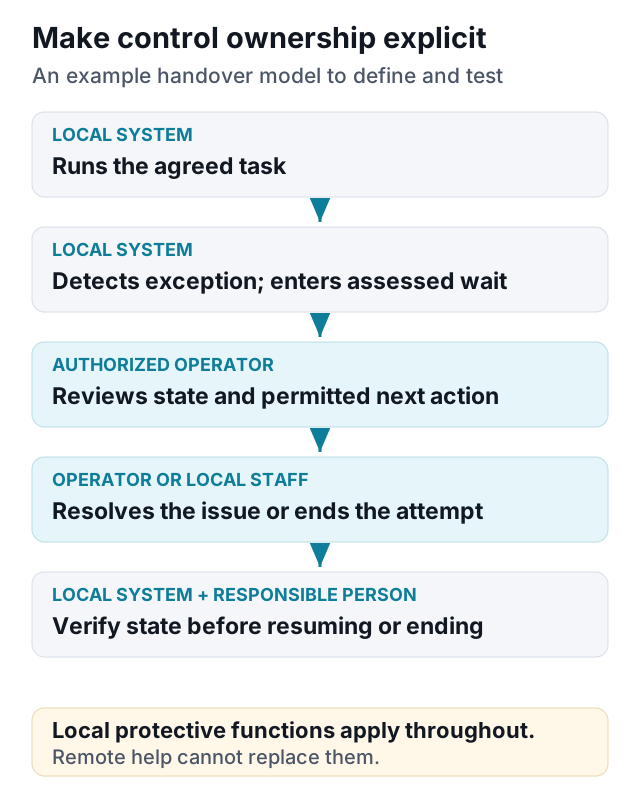
Design the handover as a state transition
“A human can take over” is not yet an operating procedure. Before a pilot, define what causes a request, what the robot does while waiting and how both sides know control has changed.
- Detect the exception. The system recognizes uncertainty, an unsupported state or a failed attempt.
- Enter the assessed waiting state. The local system follows the task-specific response defined during safety and workflow design.
- Create a clear request. The operator receives the reason, current state and information needed to decide.
- Authorize the next action. Control and permissions are explicit; local staff know whether movement may resume.
- Resolve or hand over locally. The person performs the permitted intervention or ends the robot’s attempt.
- Verify the result. The system checks the physical and workflow state before returning to its normal mode.
The waiting state cannot be one universal instruction. Holding a carton, carrying a bottle and having no object in the hand create different conditions. The robot and site need an appropriate assessment, implemented locally. A remote operator is not a substitute for the required local safety functions.
Suit, gloves and headset: different jobs
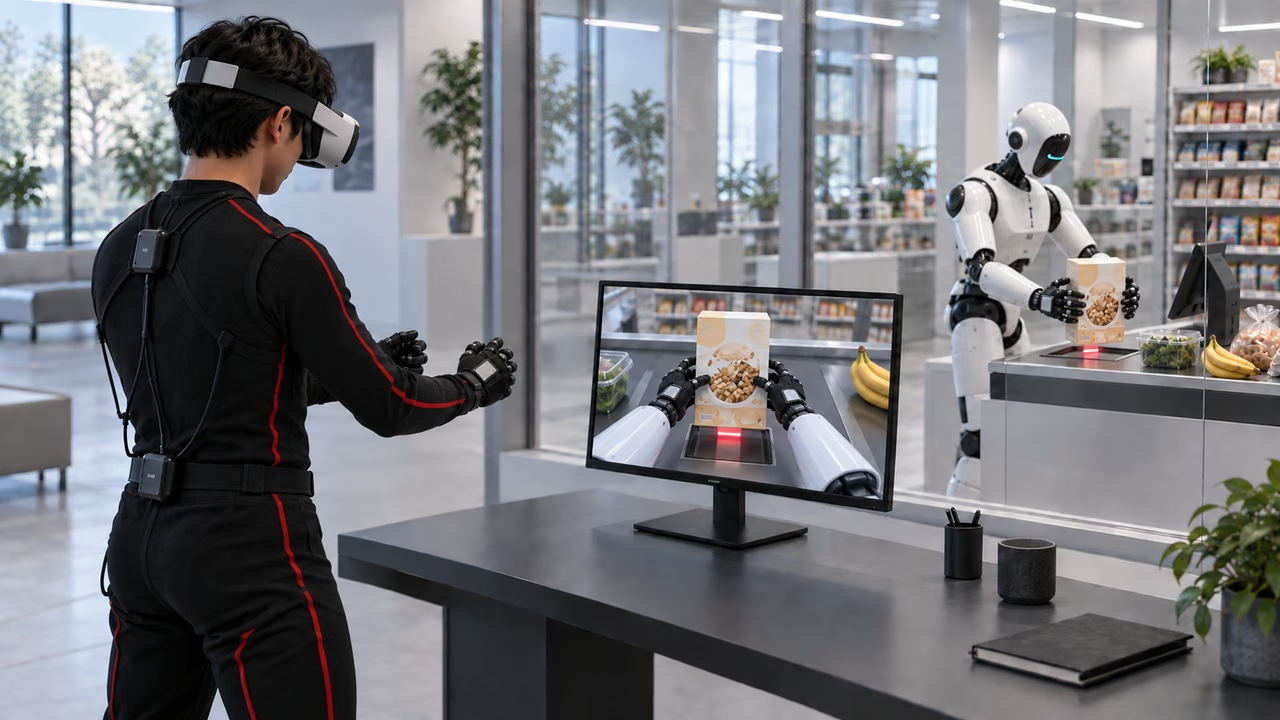
- Full-body motion-capture suit: estimates torso and limb movement so software can map selected poses onto the robot. Xsens motion-capture systems illustrate this input role. Capturing a person's posture does not itself solve robot balance or whole-body control.
- Tracking gloves: estimate finger and hand pose; locating the hand in the room may require additional tracking. MANUS documentation distinguishes hand data, calibration and external tracking. Measuring motion is separate from providing tactile or force feedback; a tracking glove does not necessarily provide either.
- VR headset: can display live robot-camera views and, where implemented, supply head-pose input. Open-TeleVision demonstrates immersive visual feedback. A nearby monitor can show the camera feed to an observer; body tracking alone cannot reveal whether a product slipped.
Calibrate suit fit, body and hand proportions, coordinate frames and the mapping to the robot's permitted motions. Check synchronization and end-to-end delay across tracking, commands, robot response and camera feedback. A sensor's sampling rate is not the complete system's latency. Suit, gloves, headset, robot and hand require compatible interfaces and tested integration; the examples above do not identify the pictured equipment or establish universal compatibility.
Give the operator useful information
A single attractive camera view may hide the contact that matters. The operator may need to see the fingertips, the destination, the interface state and nearby people. Additional views help only if they are understandable and arrive with useful timing.
Evaluate whether the interface shows the current operating mode, stale video, communication trouble and the outcome of the last command. If a screen press has not produced a confirmed response, the operator should not have to guess whether to repeat it.
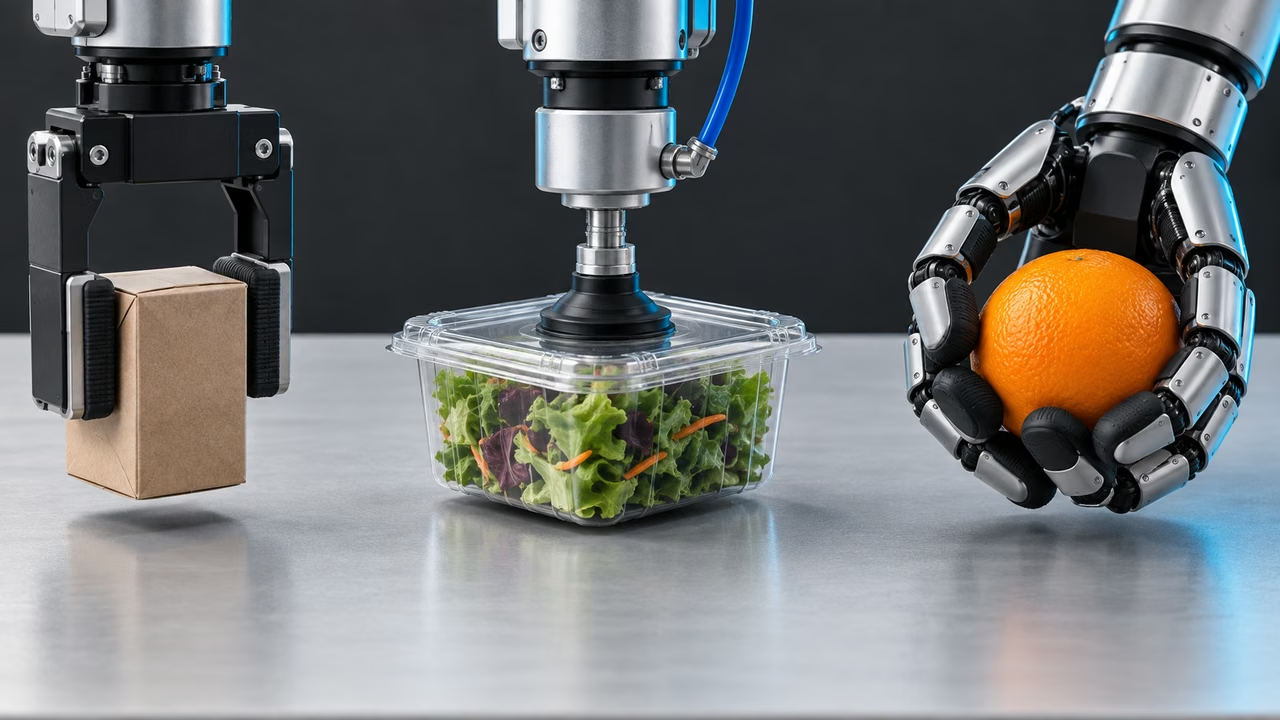
For hand control, establish how human movement maps onto the robot. Different hand proportions, finger arrangements and reachable poses mean that copying a human gesture is not always a direct geometric match. Tooling and control need to be evaluated together, as discussed in the hands and grippers guide.
Test communication failures, not only average latency
Measure the complete delay from an observation reaching the operator to the resulting action at the robot. Also test variation in that delay, stale frames, disconnection and reconnection. A low average can hide intermittent periods when the operator lacks a current view.
There is no single latency figure that makes every robot task acceptable. Slow object inspection, continuous contact motion and customer-facing interaction create different requirements. Agree the permitted behavior with the responsible engineering and site teams, and verify how local functions respond when remote communication cannot be trusted.
In a supermarket, network testing should use the intended operating area and realistic conditions. A quiet office Wi-Fi test does not represent a store’s shelving, access points or peak activity.
Calculate the human workload behind remote assistance
A robot-to-operator ratio should follow measured demand, not a marketing target. Start with the number of tasks, the fraction requiring help and the average time spent resolving each request:
Assistance minutes per hour = tasks per hour × assistance rate × handling minutes per request.
Hypothetical example: 100 tasks per hour, a 5% assistance rate and 90 seconds per request produce 7.5 operator minutes per robot-hour. This is an arithmetic illustration, not a FastLane result or a staffing commitment.
That average leaves out preparation, breaks, training, documentation, failed connections and peak bursts. Several robots can request help at once. A queue increases waiting time, which can also reduce robot throughput or disrupt a customer-facing workflow. Do not infer a safe or practical fleet ratio simply by dividing 60 by 7.5.
Track assistance by reason. Frequent help with one SKU may suggest a grasping improvement. Repeated requests at the same interface state may indicate missing task logic. A long resolution time may come from an unclear operator view. These patterns are more useful than one blended intervention rate.
Keep checkout authority and data access explicit
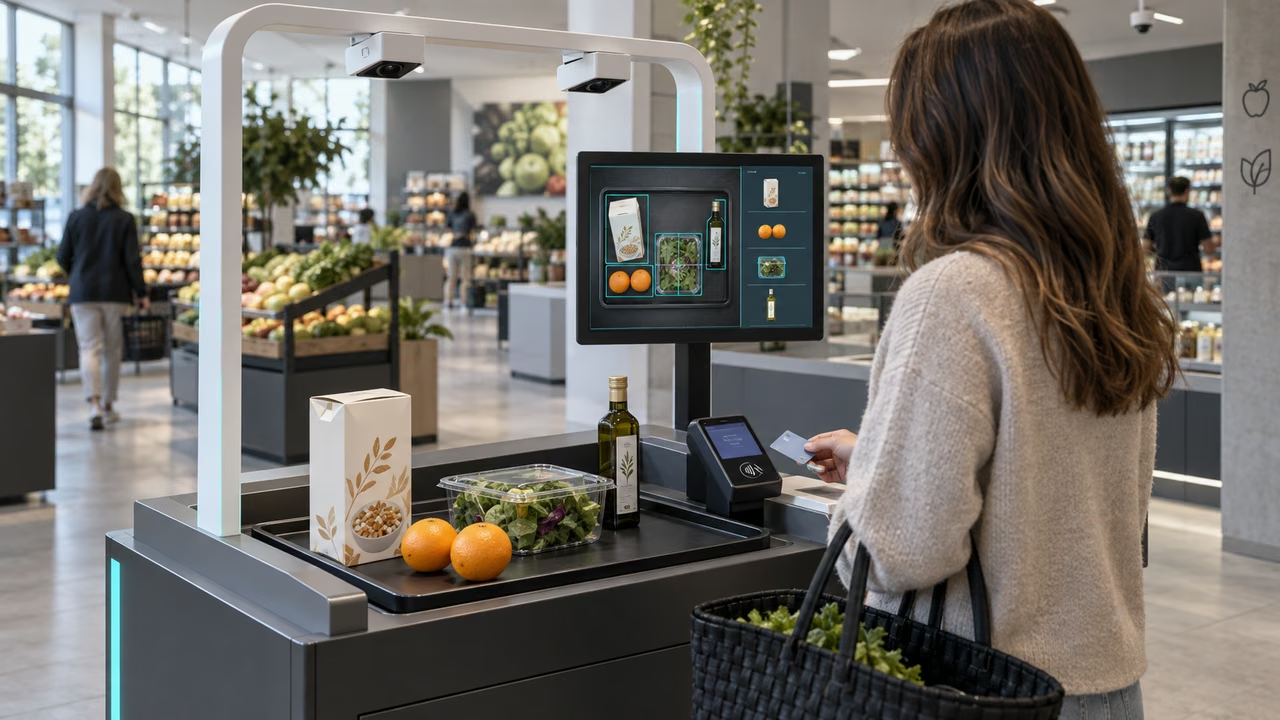
A remote person being able to view a checkout does not mean that person should perform every action. Refunds, restricted-item decisions, payment exceptions and customer disputes need clearly assigned responsibilities. A narrow first pilot can exclude these cases and hand them to the store’s established process.
Likewise, define what the remote system can see and record. Decide which views are needed, who can access them, how long records remain available and which locations provide support. Keep unnecessary customer and payment information out of the workflow where feasible. The chosen architecture and contracts should reflect the retailer’s requirements.
These questions deserve answers before a demonstration becomes a store pilot. They also help prevent a technical team from solving an exception by quietly creating a new operational dependency.
What a credible pilot report should show
- The operating mode used during each evaluated task.
- The number and causes of requests for help.
- Waiting time, operator handling time and resolution outcome.
- Local staff interventions as well as remote interventions.
- Behavior during loss of communication and interrupted handovers.
- Changes made after failures and evidence from the subsequent retest.
Teleoperation is most useful when it has a defined purpose. It can accelerate learning, make a bounded project testable and provide an explicit path for selected exceptions. Its staffing, data and technical requirements should be visible in the pilot acceptance plan.
Talk to FastLane about a defined retail workflow and the role human assistance should play. The first useful decision is which actions the robot must complete independently and which require a person.
Sources and further reading
- Xsens: examples of full-body motion-capture systems
- MANUS: hand tracking, calibration and external tracking interfaces
- Open-TeleVision: immersive teleoperation and learning from demonstrations
- AnyTeleop: vision-based dexterous arm-hand teleoperation
- NVIDIA: teleoperated demonstrations in simulation
The operational checklist and staffing example are editorial evaluation tools. They do not imply an existing FastLane remote-operations service or a guaranteed assistance ratio.